 FESCO • Faisalabad • PITC portal
This page focuses only on Faisalabad Electric Supply Company, for its consumers. Enter your 14-digit reference number to see your current fesco bill, due date, units and payment status instantly. The official portal is bill.pitc.com.pk/fescobill, and this checker takes live data from that same portal. Use this page for a fesco online bill view before the due date, and the fesco online bill check below shows amount, units and payment status from the same portal data.
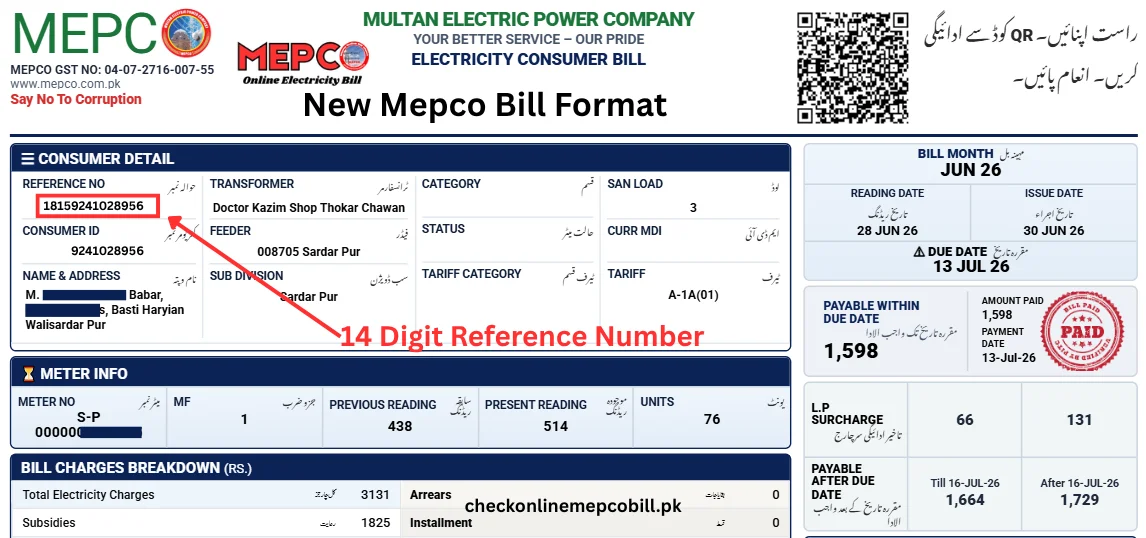
Look at the image below to see where Reference No. is printed on the bill. Enter that same 14-digit number in the checker above, without spaces or dashes, and your bill will open. This number is different for every connection. Below it there is also a 10-digit Customer ID, but only the reference number is used to check the bill.
This page is only for consumers of the Faisalabad Electric Supply Company. Enter your reference number in the checker above and your current bill opens in a new tab, straight from the official PITC portal. You can see the amount, the due date, the units used and whether the bill is paid or unpaid. Checking a bill here is free, and you do not need an account.
Your reference number has 14 digits and is printed at the top of your printed bill. Enter all 14 digits in the checker above, without spaces or dashes, and press Check Bill. The number is followed by a letter, U for urban or R for rural, but you only enter the digits. If the number is correct, the original bill opens in a new tab. A fesco bill online check uses the same number and shows the same bill, amount and due date.
Below the reference number on the printed bill there is a 10-digit customer ID. The PITC portal's own search form also accepts this customer ID as a search option. This page's checker uses the 14-digit reference number, so if you only have the customer ID, open the PITC portal form and choose the customer ID option there. You can run a fesco check bill search here or on the portal, and an online bill check fesco households use before paying shows the same figures.
The checker works the same way on a mobile phone. Open this page in your phone's browser, enter the 14-digit number and press Check Bill. The bill opens in a new tab, where you can read it, download it as a PDF, or print it from your phone if a printer is connected.
Look at the top of your printed bill. The words "Reference No." are printed in the consumer details box, with the 14-digit number next to them. The guide image above shows the exact spot. Always copy the number from your most recent printed bill, because a new connection or a changed connection can have a different number.
The same box also shows your name and address, your tariff category, your meter number, and your division and sub-division. The tariff category decides which rates apply to your bill, and the division and sub-division tell you which local FESCO office handles your connection. The billing month, the issue date and the due date are printed nearby, so check all of them before you pay.
No. The PITC portal does not open a bill from a CNIC number alone. You need the 14-digit reference number, or the 10-digit customer ID on the portal's own form. FESCO's own website does offer CNIC and mobile registration for bill alerts and messages, so if you want alerts on your phone, check the registration option on fesco.com.pk. Registration for alerts is not the same as checking a bill, and it does not replace the reference number.
A "no bill record" message usually means one of four things. The number was typed with a mistake, a space or a dash. The wrong company page was used, for example a LESCO number entered on the FESCO page. The bill for the current month has not been issued yet, so there is nothing to show. Or the number on an old printed bill no longer matches the connection. Check the number again, digit by digit, on your latest printed bill, make sure the company name on the bill is FESCO, and try again. If the number is right and the message still appears, wait a day and try again, or call 118.
After the checker opens your bill in a new tab, use your browser's print option to print it, or choose "Save as PDF" to download a duplicate copy. The duplicate carries the same details as the printed bill and is accepted at banks, post offices and payment points. Save a copy on your phone as well, so you have the reference number and the amount ready when you pay.
Open your bill through the checker and look at the payment status shown on it. If you have just paid, the status may still show unpaid until the payment is recorded. Payments usually appear within 24 to 48 hours. Keep the transaction ID or receipt from your bank app or wallet, and check again after a day or two. If the status is still unpaid after 48 hours, contact your bank or wallet first, then call 118 with the transaction ID ready.
The checker shows your current bill. For older months, your printed bills are the simplest record, so keep them filed by month. Your bank app or wallet history also shows what you paid and when. If you need a copy of an older bill and you no longer have the printed copy, visit your nearest FESCO office with your reference number and ask for it, or call 118 and ask what record they can provide.
Your total is made of several lines. The energy charge is the main one, and the other lines are adjustments, surcharges and taxes. The exact rates are printed on your bill and take precedence over any general explanation here, because rates change with NEPRA decisions and government notifications.
This is the cost of the units you used in the month, charged at the slab rate for your tariff category. The bill shows your previous and current meter readings, and the units are the difference between them. Using more units can push you into a higher slab, which is why a small rise in use can cause a larger rise in the total.
This is a fixed monthly amount for your tariff category, charged whether you use a little or a lot. Some low-use categories are exempt from fixed charges. The fixed charge line is separate from the energy charge, so two months with the same units can still have different totals if the fixed charge changes.
FPA, also called FCA, adjusts for the difference between the fuel cost built into the tariff and the actual fuel cost of generating electricity in a given month. NEPRA calculates it each month, and it is applied with a lag of two to three months, so the FPA on this month's bill relates to an earlier month's fuel cost. It can raise the bill or, when fuel costs fall, reduce it.
The FC surcharge is a per-unit charge collected to service the financing costs of the power sector's circular debt. It is shown as a separate line on the bill. Low-use lifeline consumers are exempt from this charge.
QTA is a quarterly true-up. NEPRA reviews costs every quarter and the resulting adjustment is recovered over the following months. It appears as its own line and changes from quarter to quarter.
The TR surcharge, short for tariff rationalisation surcharge, is part of the uniform tariff system. Under this system, NEPRA sets one end-user tariff across the country, and consumers in lower-cost areas pay this surcharge so that the cost is shared with higher-cost areas. It is a policy charge, not a charge for units you used.
General Sales Tax is charged on the bill as required by tax law. It is calculated on the taxable part of the bill and shown as a separate line.
Electricity duty is a provincial levy charged on electricity consumption. It appears as its own line on the bill.
The PTV licence fee is a fixed monthly fee collected through electricity bills for Pakistan Television. It does not depend on how many units you used.
Some bills carry an income tax line, for example advance tax collected through the bill where the tax rules apply. Whether it appears, and how much it is, depends on your category and the tax rules in force. If you think it was charged wrongly, raise it with FESCO and keep your tax documents ready.
Meter rent is charged where it applies to your connection type. Arrears are amounts left unpaid from earlier bills, carried forward into the current bill. A deferred amount is a part of an earlier bill that was allowed to be paid later, usually in instalments. All three are shown separately so you can see what is new and what was carried forward.
If the bill is paid after the due date, a late payment surcharge is added. The amount depends on the bill and the rules in force, and it is shown on the next bill. Paying on or before the due date avoids this charge completely.
Domestic consumers are divided into protected and non-protected categories based on average use. If your average use over the previous six months stays at or below 200 units, you keep protected status and the lower slab rates that go with it. If the six-month average crosses 200 units, you move to the non-protected category and higher slab rates apply, even if one single month was low. This is why one heavy month can affect several later bills. Your category is printed on the bill, so check it before comparing two months.
Open your bank app, Easypaisa or JazzCash, go to bill payments and choose the electricity or 1Bill option, then enter your 14-digit reference number. The amount appears automatically. Pay before the due date and save the transaction ID. You do not need a printed copy to pay online, only the reference number.
You can also pay in person at a bank branch, a post office, or a FESCO customer service centre. Take your printed bill or write down the reference number and the amount. Ask for a receipt and keep it until the paid status shows online.
Peak hours are the evening hours when demand on the grid is highest. Consumers with time-of-use meters are charged a higher rate for units used in peak hours and a lower rate in off-peak hours, so shifting heavy appliances to off-peak hours can lower their bill. Most domestic consumers on a single-phase meter are on a single tariff and are not charged separate peak rates. Check the tariff category printed on your bill to see which one applies to you, and follow any peak-hour timing notified by FESCO or NEPRA rather than guessing.
For faults, outages and billing complaints, call the helpline 118, which works around the clock. FESCO also lists a toll-free UAN, 0800-66554, and an SMS complaint service on 8118. The head office is on West Canal Road, Abdullahpur, Faisalabad, on 041-9220184 and 041-9220229. For complaint tracking and escalation, the PITC complaint system CCMS is at ccms.pitc.com.pk, and its complaint email is ccms@pitc.com.pk. Before you call, keep your reference number and a copy of the bill ready, and note the date and time of the fault or the reading you are disputing.
Your complaint is registered and you should get a complaint or tracking reference. Keep it, because you will need it for follow-up. Faults are sent to the local office for your division, and billing complaints are checked against the meter reading and the bill record. How long a fix takes depends on the type of complaint. If there is no response, follow up with the same reference number, and escalate through CCMS if the matter stays unresolved.
FESCO supplies electricity in eight districts of Punjab: Faisalabad, Sargodha, Jhang, Mianwali, Khushab, Bhakkar, Toba Tek Singh and Chiniot. It serves about 5.8 million consumers and a population of over 26 million across these districts. If your connection is in one of these districts, your bill is issued by FESCO and the checker on this page is the right one for you. Connections in Lahore, Gujranwala or Multan belong to other companies and have their own pages on this site.
The Faisalabad Electric Supply Company was set up in 1998 and distributes electricity under a licence from NEPRA. It buys power from the national grid and delivers it to homes, shops, farms and factories in its eight districts, and it issues the monthly bills for those connections. People often call the bill a WAPDA bill, but WAPDA no longer issues household electricity bills. The company name printed on the bill is FESCO. FESCO is also among the distribution companies in the government's privatisation programme, which is covered in the news articles below.
FESCO Bill Check answers the bill question in under a minute, but offices still handle the work that needs a visit, a survey or a meter. FESCO's head office is on West Canal Road, Abdullahpur, Faisalabad. The company divides its area into six operation circles, each led by a Superintending Engineer, and each circle is divided into divisions and then sub-divisions. The sub-division printed on the bill is the office that holds the connection record, arranges meter reading and carries out disconnection and reconnection work, so it is the first office to visit for a correction, a new connection enquiry or a complaint the helpline has not resolved.
| Operation circle | Headquarters city | Districts it mainly covers |
|---|---|---|
| 1st Circle | Faisalabad | Faisalabad city area, Jaranwala, Chak Jhumra |
| 2nd Circle | Faisalabad | Faisalabad suburbs, Samundri |
| Jhang Circle | Jhang | Jhang, Toba Tek Singh, Chiniot, Bhakkar (parts) |
| Toba Tek Singh Circle | Toba Tek Singh | Toba Tek Singh, Gojra, Kamalia, Pirmahal |
| Sargodha Circle | Sargodha | Sargodha, Khushab |
| Mianwali Circle | Mianwali | Mianwali, Bhakkar (parts) |
Older descriptions of FESCO show four circles, because the Toba Tek Singh and Mianwali circles were carved out of the older Jhang and Sargodha circles as the network grew. The six-circle structure above follows FESCO's own listings. Each circle is divided into divisions and sub-divisions, and division names change when the network is reorganised, so the bill remains the final word on which division serves a connection. When visiting any office, take the CNIC, the latest bill showing the reference number, and any complaint number already issued.
FESCO supplies eight districts of Punjab. The table below sets out each district and the main towns in it. The district list is published by FESCO; the town lists describe the settled areas of each district in general geographic terms.
| District | Main towns |
|---|---|
| Faisalabad | Faisalabad city, Jaranwala, Samundri, Tandlianwala, Chak Jhumra |
| Sargodha | Sargodha, Bhalwal, Shahpur, Sillanwali, Kot Momin, Sahiwal (town in Sargodha district) |
| Jhang | Jhang, Shorkot, Ahmedpur Sial, Athara Hazari |
| Mianwali | Mianwali, Isakhel, Piplan, Kundian |
| Khushab | Khushab, Joharabad, Noorpur Thal, Quaidabad, Naushera |
| Bhakkar | Bhakkar, Darya Khan, Kalurkot, Mankera |
| Toba Tek Singh | Toba Tek Singh, Gojra, Kamalia, Pirmahal |
| Chiniot | Chiniot, Bhowana, Lalian |
Two cautions apply. First, Bhakkar appears in both the Jhang and Mianwali circle listings, so the circle named on the bill decides which office handles a connection there. Second, the town called Sahiwal in Sargodha district is not Sahiwal city, which lies in Sahiwal district and is served by MEPCO; the two places share a name and are often confused. Consumers in Lahore district belong to LESCO and consumers in Gujranwala district to GEPCO, even where their towns sit close to the FESCO boundary.
A new connection is applied for through the national Electricity New Connection (ENC) portal, where the applicant selects FESCO and the sub-division shown on a neighbour's bill, uploads the required documents and receives a tracking number. The usual documents are the applicant's CNIC, proof of ownership or legal occupation of the premises, a neighbour's recent bill and a wiring test report from a licensed contractor. After a site visit, FESCO issues a demand notice showing the approved load and the charges. The notice must be paid within the validity period printed on it, and only against the official notice; field staff do not collect connection payments in cash.
A load extension follows the same route when the sanctioned load is no longer enough, and the approved load and any meter change appear on the demand notice. A name change is handled at the area office with the CNIC, the latest bill and the documents supporting the change. If a meter reading looks wrong, photograph the meter showing the reading, note the date, and report it through the helpline or SMS service or at the sub-division office, keeping the photograph for the visit that follows. A faulty, burnt or stopped meter should be reported the same way, and the meter must not be opened or repaired by the consumer, since it is company property and interference with it is treated as tampering.
Agricultural connections, including tubewells, form a large part of FESCO's work across its eight districts and are applied for through the same ENC route, with the load and tariff category decided on the application and the survey. Net metering for solar systems follows NEPRA's Distributed Generation and Net Metering Regulations of 2015: the system must be installed by a certified installer, the application goes to FESCO with a certificate from the Electric Inspector, and after technical review an agreement is signed and NEPRA issues a generation licence. FESCO then installs a bi-directional meter recording both the units taken from the grid and the surplus units sent back. The rules on system size and on the treatment of exported units change from time to time, so the current regulations and FESCO's own procedure should be checked before a system is bought.
Three items on a bill cause the most confusion after the total itself. The maximum demand indicator (MDI) figure, seen on time-of-use and three-phase meters, records the highest load drawn during the month and can affect the charges for larger connections. A detection bill is raised when a meter is found to have recorded less than the electricity actually used, for example after tampering or a fault; it is based on an assessed consumption and can be challenged through the complaint route with evidence, including photographs of the meter. An instalment plan, agreed at the office, splits an outstanding amount over coming months, and each instalment then appears as its own line until it is cleared. Comparing the individual lines of two months, rather than only the totals, usually shows which line caused a change.
A complaint should start at the sub-division office or through the helpline and the CCMS complaint system, and the complaint number received should be kept safe. If there is no response, follow up with the same number at the division office, then at the circle office, and then at the head office. Billing and metering disputes that stay unresolved can also be taken to the Electric Inspector, a Punjab government office independent of FESCO, which hears disputes about metering, billing and collection of tariff. FESCO's districts fall under two Electric Inspector regions: the Faisalabad Region office covers Faisalabad, Chiniot, Jhang and Toba Tek Singh, and the Sargodha Region office covers Sargodha, Khushab, Mianwali and Bhakkar. If the matter remains unresolved after that, it can be taken to NEPRA's complaint system with the complaint number, the reference number and copies of the bills concerned.
No. You need the 14-digit reference number for this checker, or the 10-digit customer ID on the PITC portal's own form. A name, address or CNIC alone does not open a bill. The number is printed at the top of any old printed bill for the connection.
No. Checking a bill on this page and on the PITC portal is free. You only pay the bill amount itself, through your bank or wallet, when you choose to pay.
Even with the same units, the total can change because of the FPA for an earlier month, a quarterly adjustment, a change in fixed charges, or a move from protected to non-protected status. Compare the individual lines on the two bills, not just the totals, and the reason is usually visible on one line.
There is no fixed grace period you can rely on. The due date printed on the bill is the last date to pay without a late payment surcharge, so pay on or before that date. If you pay late, the surcharge appears on the next bill.
The reference number has 14 digits and is the main key for checking a bill. The consumer or customer ID has 10 digits and is printed below it on the bill. Both identify the same connection, but this checker uses the reference number.
FESCO's website offers CNIC and mobile registration for bill alerts and messages. Check the registration option on fesco.com.pk and register your own mobile number there. Alerts do not replace the printed or online bill, which is where the full details appear.
Take a clear photo of the meter showing the reading, note the date and time, and compare it with the reading printed on the bill. If they do not match, call 118 or send an SMS to 8118 with your reference number and the reading, and keep the photo for the visit that follows.
Yes, name changes are handled at the FESCO office for your area. Visit the office with your CNIC, the latest bill and the documents that support the change, and ask for the name-change procedure. The office will tell you the form and any supporting papers needed for your case.
Yes, in everyday speech. People say WAPDA bill for any electricity bill in Pakistan, but the bill for Faisalabad and the surrounding districts is issued by FESCO, and FESCO is the name printed on it.
No. This is an independent bill-checking page. It takes live bill data from the official PITC portal, but it is not owned by FESCO, PITC or WAPDA. FESCO's own website is fesco.com.pk, and the official bill portal is bill.pitc.com.pk/fescobill.